Executive Summary
What the Service Covers
Appeals against conviction, appeals against acquittal, criminal revisions, applications for suspension of sentence and bail pending appeal, murder references and petitions for leave to appeal to the Supreme Court.
Who Needs It
A person convicted by a Magistrate, Sessions Court or special court in Karachi, a complainant whose accused has been acquitted, and families who need a sentence suspended while the appeal is heard.
Fee, Time and How to Start
The fee is quoted after we read the judgment and the record and depends on the forum and the volume of evidence. Appeal hearing dates are fixed by the court, so we do not promise a timeline. Send the judgment on WhatsApp +92 302 6644789; the work is advocate-led and our firm has practised since 1985.
Where a Criminal Appeal Lies
The Code of Criminal Procedure decides the appellate forum by the court that passed the sentence and the sentence passed. Appeals from many Magistrate convictions lie to the Sessions Court under section 408, while appeals from convictions by a Sessions Court lie to the High Court under section 410. Special laws, such as those on narcotics, anti-terrorism and accountability, provide their own appeal routes, usually to the High Court.
A death sentence passed by a Sessions Court must be confirmed by the High Court under section 374, and the confirmation reference is heard with any appeal filed by the convict. We confirm the forum before drafting, because an appeal filed in the wrong court wastes time the client cannot spare.
| Remedy | Forum | Main provision |
|---|---|---|
| Appeal against conviction (Magistrate) | Sessions Court, in the cases provided | Section 408 CrPC |
| Appeal against conviction (Sessions Court) | Sindh High Court | Section 410 CrPC |
| Appeal against acquittal | Sindh High Court | Section 417 CrPC |
| Criminal revision | Sessions Court or Sindh High Court | Sections 435 and 439 CrPC |
| Suspension of sentence pending appeal | The appellate court | Section 426 CrPC |
| Petition for leave to appeal | Supreme Court of Pakistan | Article 185 of the Constitution |
Time Limits a Criminal Appeal Lawyer in Karachi Watches
The Limitation Act sets short periods for criminal appeals, commonly thirty or sixty days depending on the forum, and an appeal against acquittal has its own period. The time taken to obtain a certified copy of the judgment is excluded, which is why we apply for the copy on the day the judgment is announced and note every date.
An appeal filed late needs an application for condonation of delay with a sufficient explanation for each day. Courts are strict about this, so a late appeal starts at a real disadvantage. A convict in jail may also file an appeal through the jail authorities, and we check whether such a jail appeal has already been sent before filing a fresh one.
Grounds of Appeal Against Conviction
An appeal is a rehearing on the record. The appellate court can examine whether the evidence was properly appreciated, whether contradictions were ignored, whether the prosecution proved its case beyond reasonable doubt, and whether legal procedure was followed at trial. The superior courts have long held that where a reasonable doubt arises, its benefit goes to the accused as of right.
We read the entire evidence, not just the judgment, and draft grounds that point to specific pages and statements. Common grounds include unexplained delay in the FIR, inconsistent eyewitness accounts, defects in recovery or forensic evidence, and failure to put incriminating material to the accused in his statement under section 342.
How the Appeal Record Is Prepared
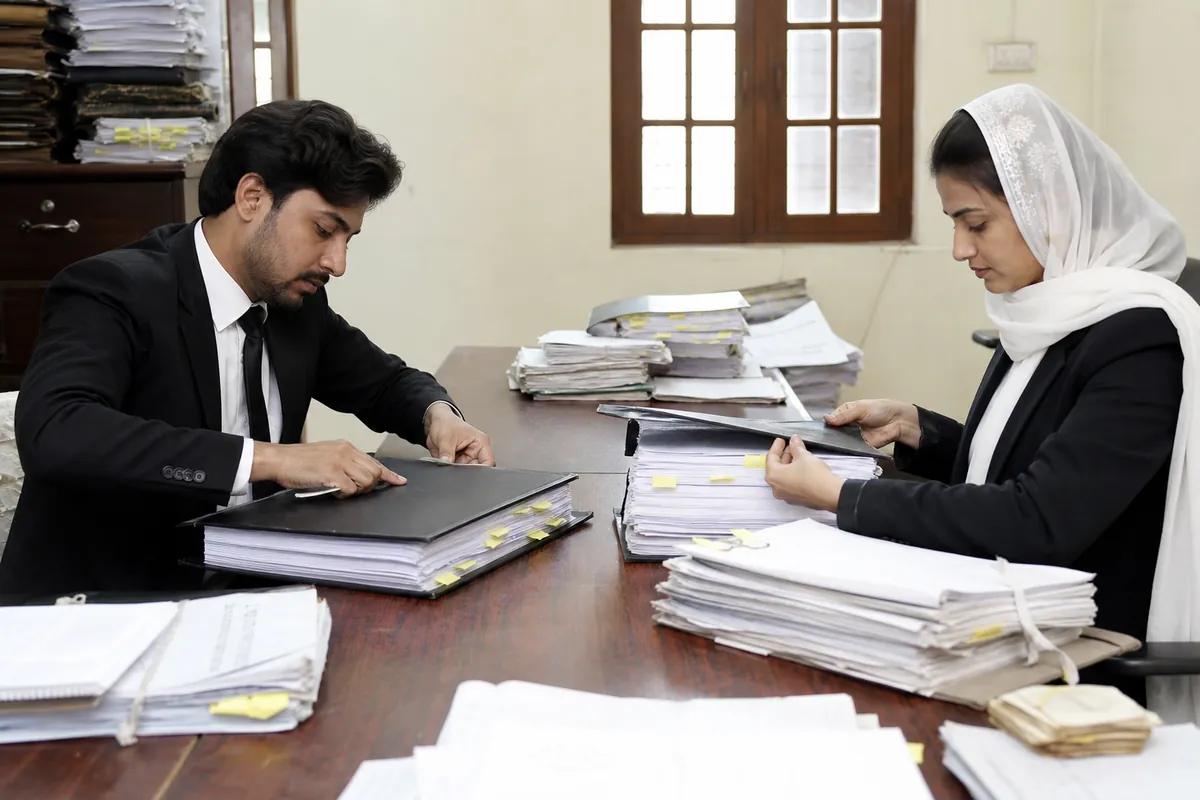
An appeal before the High Court is argued from a paper book: the FIR, the charge, the statements of witnesses, the documents exhibited, the statement of the accused and the judgment, arranged and indexed. A clear paper book lets the bench find the contradiction or the missing link quickly, and a disorganised one buries the best point.
We check that every deposition and exhibit relied on is included and legible, mark the passages the arguments depend on, and prepare a short written synopsis where the court allows it. Where parts of the trial record are missing, we apply to the trial court for copies before the hearing rather than during it.
Death Sentences and Murder References
Where a Sessions Court passes a death sentence, the case comes to the High Court as a reference for confirmation, and the convict's appeal is heard with it. The High Court examines the whole evidence independently before confirming, reducing or setting aside the sentence. These cases demand the most careful preparation, and families should contact counsel as soon as the judgment is announced.
Suspension of Sentence and Bail Pending Appeal
Filing an appeal does not by itself release a convict. An application under section 426 asks the appellate court to suspend the sentence and release the appellant on bail while the appeal is pending. Courts consider the length of the sentence, the strength of the grounds, the time the appeal is likely to take and the conduct of the appellant.
Section 426 also contains statutory grounds where an appeal against a sentence of a given length has not been decided within the period set by the section, unless the delay is attributable to the appellant. We calculate these periods from the record before relying on them.
Appeals Against Acquittal
A complainant or the State may challenge an acquittal under section 417. The courts apply a stricter test here: an acquittal strengthens the presumption of innocence, and it is generally interfered with only where the trial court's reasoning is perverse, arbitrary or based on a misreading of evidence.
We act for complainants who believe the evidence was ignored, and for acquitted persons who must defend the judgment in their favour. In both roles the work turns on a close reading of the record. An acquitted person who is served with notice of such an appeal should respond promptly, because the High Court can, in a suitable case, set the acquittal aside and convict.
Criminal Revisions and Interim Orders
Not every order can be appealed. Orders made during trial, such as framing of charge, refusal to summon a witness or orders on applications, may be challenged through revision under sections 435 and 439, where the court examines the legality and propriety of the order.
Revisions are discretionary, and courts are reluctant to interrupt a trial on minor points. We file them only where the order genuinely affects the outcome or the rights of the client, and we tell the client when it is wiser to raise the point later in an appeal against the final judgment.
Further Appeal to the Supreme Court
Against a High Court judgment, the next step is usually a petition for leave to appeal to the Supreme Court under Article 185 of the Constitution. Leave is granted where a substantial question of law or a serious miscarriage of justice is shown. The petition has its own time limit and format, and it must be filed through an Advocate-on-Record or an Advocate Supreme Court.
Criminal Appeal Lawyer in Karachi Fees and Timelines
Our fee depends on the forum, the volume of evidence, whether a suspension application is needed and the number of hearings. It is quoted after we read the judgment and the record. High Court appeals are fixed according to the court's roster, and some take considerable time to be heard, so we give a realistic view rather than a date.
We do not promise that a conviction will be set aside or a sentence reduced. We tell you honestly whether an appeal has strong grounds before you decide to file.
What to Send Your Criminal Appeal Lawyer in Karachi
Send the judgment, the date it was announced, the FIR, the charge, any bail orders, and the evidence if you have copies. Tell us where the convict is held and whether any earlier appeal or application has been filed. If only the operative part of the judgment is available, send that and we will apply for the full certified copy.
For bail before trial see our bail lawyer in Karachi page, and for trial defence see our criminal defence lawyers in Karachi page. Our network also lists criminal lawyers in Karachi and Islamabad.
Criminal Appeal Lawyer in Karachi: Who Will Handle Your Matter

Syed Akhtar Rizvi
Advocate Supreme Court of Pakistan

Mohsin Ali Shah
Senior Legal Consultant, M.A., LL.B. (practising since 1985)
Syed Akhtar Rizvi, Advocate Supreme Court of Pakistan, argues criminal appeals and revisions before the Sindh High Court and supervises Supreme Court petitions. Syed Mohsin Ali Shah, Senior Legal Consultant, practising since 1985, reviews the record and the grounds before filing.
Criminal Appeal Lawyer in Karachi — Frequently Asked Questions
What does a criminal appeal lawyer in Karachi do?
They read the judgment and evidence, file the appeal or revision within time, apply for suspension of sentence and argue the case before the appellate court.
How long do I have to file a criminal appeal?
The Limitation Act sets short periods, commonly thirty or sixty days depending on the forum. Time spent obtaining the certified copy is excluded.
Will I be released when the appeal is filed?
Not automatically. An application to suspend the sentence under section 426 must be made and decided by the court.
Can the complainant appeal against an acquittal?
Yes, under section 417, but the court applies a strict test before interfering with an acquittal.
What is a criminal revision?
A remedy under sections 435 and 439 to challenge the legality or propriety of an order, often an interim order during trial.
Can new evidence be produced in appeal?
Only in limited circumstances with the court's permission. An appeal is decided mainly on the trial record.
Which court hears my appeal?
It depends on the court that convicted you and the sentence. Sessions Court convictions usually go to the Sindh High Court.
Can I appeal to the Supreme Court?
A petition for leave to appeal may be filed against a High Court judgment under Article 185 of the Constitution.
My appeal deadline has passed. What can I do?
An application for condonation of delay may be filed with a sufficient explanation, but courts are strict.
How much does a criminal appeal cost?
The fee depends on the forum, the record and the hearings. It is quoted after we read the judgment.
Speak to a Criminal Appeal Lawyer in Karachi Today
Send the judgment on WhatsApp +92 302 6644789 and our team will tell you the deadline, the forum and whether the grounds are strong. Calls are taken from 10 am to 10 pm.
Visit Karachi Office 1 (Head Office) at 2nd Floor, Supreme Corner, Johar Chowrangi, Gulistan-e-Jauhar, or Karachi Office 2 at Mezzanine Floor, Main Jami Commercial, Phase 7, DHA. This page is general information and not advice on your case.
Official Sources and Legal References
Reviewed by: Syed Akhtar Rizvi, Advocate Supreme Court of Pakistan
Published by: Advocates of Pakistan
Last updated: 21 November 2026